Subconscious Reprogramming While You Sleep
How to Train Your Mind for Positive Change
What if the final thoughts you think before falling asleep could help shape the thoughts, emotions, and behaviors you carry into tomorrow?
That is the idea behind subconscious reprogramming while you sleep.
It is often presented as a mysterious manifestation technique: listen to affirmations overnight, visualize your dream life, and wake up transformed. Reality is more grounded—and, in many ways, more interesting.
Your brain continues processing information while you sleep. Sleep plays an important role in memory consolidation, emotional processing, and learning. Research also suggests that carefully timed sensory cues can influence the consolidation of previously learned information during sleep.
That does not mean you can simply play a recording saying “I am wealthy” eight hours a night and expect money to appear in your bank account.
The real opportunity is subtler.
You can use your pre-sleep state to reinforce intentional thoughts, rehearse desired behaviors, calm mental resistance, and create stronger associations between the person you want to become and the actions you take during the day.
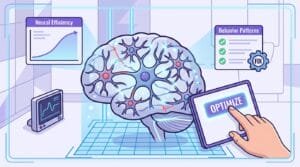
What Is Subconscious Reprogramming While You Sleep?
Subconscious reprogramming while you sleep refers to practices designed to influence deeply established thought patterns through repetition, relaxation, visualization, affirmations, and sleep-related learning processes.
The word “subconscious” is commonly used in personal development, although neuroscience generally talks about automatic processing, implicit memory, learned associations, and unconscious mental processes.
Think about how many things you do without consciously thinking about them.
You do not need to mentally calculate every movement required to brush your teeth. You recognize familiar faces almost instantly. A particular song can trigger an emotional memory before you consciously understand why.
These automatic responses are built through learning and repetition.
Your goal is not to control your sleeping brain like a computer.
Instead, you are deliberately creating mental associations while awake and around bedtime that can become increasingly familiar and accessible.
Why Does the Brain Respond to Repetition?
Your brain is constantly changing in response to experience.
When you repeatedly think, feel, or perform something, the neural networks involved can become more efficient and familiar. This principle is one reason repetition is so important when learning a skill or changing a habit.
Imagine practicing confidence.
You repeatedly visualize walking into a meeting with relaxed shoulders, steady breathing, clear speech, and calm eye contact. You then practice speaking confidently in real situations.
The visualization does not replace action.
It supplements it.
Over time, the imagined behavior and the physical behavior can become increasingly familiar.
The Reticular Activating System and Attention
You may have heard that the brain’s reticular activating system (RAS) acts like a filter that determines what you notice.
There is some truth behind this popular explanation, although online manifestation content often oversimplifies it.
Your brain receives enormous amounts of sensory information every moment. Attention and filtering systems help determine which information receives greater processing.
When you repeatedly focus on a particular goal, you may become more likely to notice relevant opportunities, information, and environmental cues.
For example, decide that you want to buy a particular model of car.
Suddenly, you seem to see that car everywhere.
The cars did not magically multiply overnight. Your attention changed.
The same principle can apply to goals. When you repeatedly clarify what matters to you, your brain becomes better prepared to recognize information and opportunities related to that objective.
Subconscious Reprogramming While You Sleep and Visualization
Visualization becomes more powerful when you stop treating it as simply imagining a photograph of your future.
Instead, create an internal experience.
Close your eyes.
See the room.
Hear the sounds.
Notice the temperature.
Feel your feet against the floor.
Hear yourself speaking.
Most importantly, experience the emotional state associated with the scene.
This is where visualization moves beyond passive daydreaming.
Create an Internal Movie
Suppose your goal is to become more confident in your business.
Do not simply imagine yourself “successful.”
Build a short internal movie.
See yourself opening your laptop in the morning.
Hear the notification of a new enquiry.
Feel your shoulders relax rather than tense.
Picture yourself answering the phone calmly.
Hear your own voice explaining your service with confidence.
Feel the satisfaction of knowing you can handle the conversation.
Then imagine yourself taking the next practical step.
The emotional component matters because goals are not merely intellectual concepts. They become connected with memories, sensations, expectations, and learned behaviors.
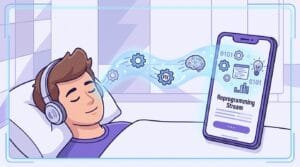
How to Practice Subconscious Reprogramming While You Sleep
You do not need an elaborate bedroom setup or hours of recordings.
A simple routine can be more useful.
1. Choose One Specific Outcome
Avoid trying to reprogram your entire life in one night.
Choose one theme.
Examples include:
- Confidence
- Consistency
- Healthy habits
- Financial discipline
- Creative confidence
- Calmness
- Motivation
- Better communication
Your subconscious practice should have a clear direction.
2. Create a Short Statement
Use language that feels believable enough to engage with.
Instead of:
“I am instantly the most successful person in the world.”
Try:
“I am becoming more confident, disciplined, and willing to take meaningful action every day.”
The second statement gives your mind something realistic to rehearse.
3. Visualize Before Falling Asleep
Spend approximately five to ten minutes creating your internal movie.
Do not force it.
Relax your body first.
Slow your breathing.
Allow the day’s noise to settle.
Then imagine one short scene that represents progress toward your goal.
4. Add Emotion
Ask yourself:
“If this were already becoming real, how would I feel?”
Perhaps you would feel relief.
Maybe confidence.
Perhaps gratitude, excitement, freedom, security, or calm.
You do not need to manufacture an enormous emotional high.
A quiet feeling of certainty can be enough.
5. Repeat Consistently
One night rarely changes an established behavioral pattern.
Repetition matters.
Think of this as mental conditioning rather than a magical overnight transformation.
Practice the same theme for several weeks while also changing your behavior during waking hours.
A 5-Minute Sleep Visualization Ritual
Try this tonight.
Lie comfortably in bed and close your eyes.
Take several slow breaths.
Relax your forehead.
Relax your jaw.
Drop your shoulders.
Now imagine waking up tomorrow as the version of yourself who is already taking better action.
See yourself getting out of bed.
Hear the sounds around you.
Feel your feet touch the floor.
Now move forward to one important action connected with your goal.
If your goal is fitness, see yourself putting on your shoes and beginning your walk.
If your goal is business, see yourself contacting a potential customer.
If your goal is creativity, see yourself opening your notebook and writing.
If your goal is confidence, see yourself having the conversation you have been avoiding.
Now experience the moment after taking that action.
Feel the quiet satisfaction.
Tell yourself:
“This is who I am becoming. Tomorrow, I act accordingly.”
Then let the scene fade naturally as you fall asleep.
The important part is not achieving a mystical state.
It is creating a clear mental rehearsal and connecting it with a real behavior.
Can Sleep Affirmations Really Reprogram Your Mind?
This is where it is important to separate useful practice from exaggerated claims.
Listening to affirmations while completely asleep is not proven to rewrite your personality or install new beliefs automatically.
However, auditory information presented during sleep can interact with memory and learning under particular experimental conditions. Researchers have studied forms of targeted memory reactivation in which cues associated with previously learned material are presented during sleep.
That is very different from claiming that ordinary overnight affirmations can completely reprogram your subconscious.
A better strategy is to use affirmations before sleep, when you are relaxed but still conscious, and combine them with visualization and daytime action.
You can also use quiet audio during a relaxation routine if it helps you focus.
The recording is not the magic.
The repetition, attention, emotional association, and subsequent behavior are what make the practice useful.
What About Fear, Doubt, and Overthinking?
One of the biggest problems with manifestation practices is the pressure to feel positive all the time.
That is unnecessary.
You will have doubts.
You will have difficult days.
You may visualize success at night and wake up anxious the next morning.
That does not mean you failed.
Trying to suppress every negative thought can actually make you more preoccupied with it.
Instead, acknowledge the thought.
“I am worried this will not work.”
Then respond:
“I can feel uncertain and still take the next useful step.”
This is a much healthier approach to mental conditioning.
You are not trying to hypnotize yourself into believing that every desired outcome is guaranteed.
You are training yourself to respond differently when fear appears.
Turn Visualization Into Physical Reality
This is the part many manifestation routines miss.
Your internal movie needs an external sequel.
If you visualize becoming financially successful but never improve your skills, contact customers, create offers, manage your money, or solve problems, visualization alone will not produce the desired result.
Use the following formula:
Imagine → Feel → Rehearse → Act → Repeat
Your visualization gives your brain a target.
Your action gives that target physical expression.
Your feedback tells you what needs changing.
Then you visualize and practice again.
Three Micro-Actions to Take Tomorrow
After your nighttime visualization, choose three small actions for the next day.
They should be so clear that you know exactly what “done” means.
For example:
- Contact one potential customer.
- Spend 20 minutes learning a valuable skill.
- Complete one task you have been procrastinating on.
Small actions matter because they create evidence.
Every time you act in alignment with the identity you are rehearsing, you give your brain another experience to learn from.
The Best Time to Reprogram Your Mind Is Not Only at Night
Bedtime is valuable because distractions are decreasing and your attention can become more inwardly focused.
But your waking hours are where the real conditioning happens.
If you tell yourself at night that you are becoming confident but spend the following day avoiding every uncomfortable conversation, your behavior reinforces the old pattern.
Instead, use your nighttime visualization to rehearse the behavior you intend to practice tomorrow.
Then look for the opportunity during the day.
That creates a powerful loop:
Nighttime rehearsal → daytime action → real-world feedback → nighttime reflection.
Over time, the gap between imagining a behavior and performing it can become smaller.
Key Takeaways
- Subconscious reprogramming while you sleep is best understood as a supportive mental-conditioning practice, not a magical shortcut.
- Repetition can strengthen familiar thought and behavioral patterns.
- Visualization becomes more useful when it includes sensory detail and emotion.
- The RAS is involved in attention and information filtering, but it should not be treated as a magical manifestation mechanism.
- Sleep supports memory consolidation and emotional processing.
- Pre-sleep visualization may be more practical than relying on passive overnight affirmations.
- Doubt does not mean your practice is failing.
- Visualization should always be paired with real-world action.
- Small, repeated actions create evidence for the identity you are trying to build.
Final Thoughts on Subconscious Reprogramming While You Sleep
Subconscious reprogramming while you sleep can become a meaningful part of a personal growth routine when you approach it with both imagination and realism.
You do not need to convince yourself that everything you want will magically appear.
You need to become increasingly familiar with the thoughts, emotions, decisions, and behaviors associated with the person you want to become.
Tonight, create the internal movie.
See it.
Hear it.
Feel it.
Let yourself experience the calm confidence of taking the next step.
Then, tomorrow, take that step.
That is where manifestation becomes grounded.
Your imagination provides the rehearsal.
Your emotions give it meaning.
Your repeated actions give it physical form.
The goal is not to escape reality while you sleep.
It is to wake up better prepared to participate in creating the reality you want.
Frequently Asked Questions
1. Does subconscious reprogramming while you sleep really work?
It can support learning, mental rehearsal, and habit change, particularly when combined with conscious repetition and real-world behavior. However, there is no strong scientific evidence that simply listening to affirmations while completely asleep can automatically rewrite your subconscious or manifest specific outcomes.
2. What should I listen to for subconscious reprogramming while you sleep?
Choose calm, positive material that supports a goal you are already consciously working toward. Short affirmations, relaxation recordings, or guided visualizations can be useful before sleep. Avoid treating overnight audio as a substitute for practice and action during the day.
3. How long does subconscious reprogramming while you sleep take?
There is no universal timeline. Established habits and beliefs generally develop through repeated experiences, so meaningful change is more likely to come from consistent practice over weeks and months rather than expecting one night to transform you. Focus on repeating the same useful mental rehearsal while taking small actions that support it during the day.